For most of the cloud era, data-center power strategy was built around one primary goal: availability.
Secure enough utility capacity. Build redundant electrical paths. Install UPS systems. Add backup generation. Keep the servers running through outages. Optimize efficiency. Improve power usage effectiveness (PUE). Reduce downtime.
That model was appropriate for the previous generation of digital infrastructure.
AI changes the equation.
The largest AI data centers are not simply bigger versions of traditional facilities. They are denser, more concentrated, faster to deploy, and more dynamic electrically. They are arriving at a time when utilities and grid operators are dealing with a surge in mega data center applications.
That is why AI data centers require a new power playbook.
The old playbook was about uptime.
The new playbook is about uptime plus power readiness.
Data-center power demand is becoming material
The scale of the shift is now large enough to matter in infrastructure planning.
According to the U.S. Department of Energy and Lawrence Berkeley National Laboratory, U.S. data-center electricity use increased from 58 TWh in 2014 to 176 TWh in 2023. By 2028, it could increase by 2–3 times reaching 325 to 580 TWh, representing roughly 6.7% to 12% of total U.S. electricity consumption, depending on broader demand growth.
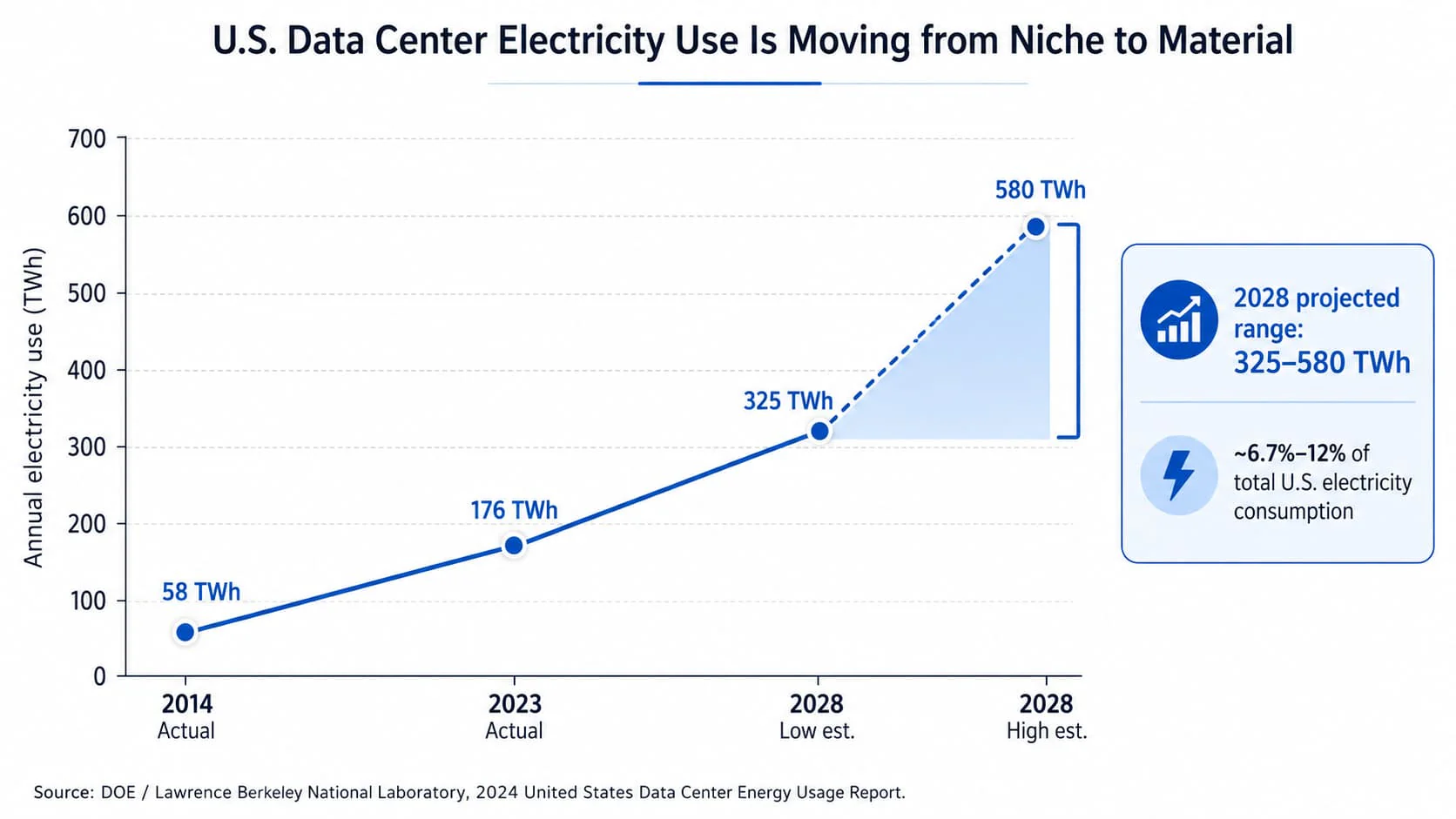
Globally, the International Energy Agency (IEA) estimates that data-center electricity consumption could more than double to about 945 TWh by 2030. The IEA also notes that AI is the most important driver of this growth, alongside broader demand for digital services.
The issue is not that data centers are the largest source of electricity demand in the economy. Rather, they are growing quickly, clustering geographically, and requiring large blocks of firm power on timelines that are much faster than traditional grid expansion cycles.
That creates a new planning problem for developers, utilities, grid operators, regulators, and communities.
The clocks are different
A core challenge is the mismatch in infrastructure clocks.
AI data-center developers think in GPU availability, customer commitments, model cycles, quarterly capacity plans, and speed to market.
Utilities and grid operators think in interconnection studies, substation upgrades, transformers, transmission constraints, generation adequacy, commissioning, and multi-year reliability planning.
Neither side is wrong. They are operating on different clocks.
The IEA highlights this timing challenge directly. Its analysis notes that data centers can often be built in two to three years, while the energy infrastructure required to serve them can take longer because of planning, permitting, financing, and construction timelines.
This timing mismatch is one reason power has become a board-level issue for AI infrastructure. It affects site selection, financing, customer commitments, go-live dates, public perception, and ultimately the ability to turn announced capacity into power availability.
The new power playbook has to reconcile those clocks.
AI data centers are different electrical loads
Traditional data centers were already important electricity customers. But AI data centers introduce a different profile.
They are often larger. They can be denser. They may cluster in specific regions. Their load is more dynamic. Their business need for uptime is intense. And their interconnection requests can arrive in bursts that are difficult for existing planning processes to absorb.
In Texas, ERCOT has become one of the early laboratories for AI-scale load growth. ERCOT’s Large-Load Working Group highlights the scale and speed of new interconnection interest from AI data centers and other large loads, creating the need for more structured review and planning processes.
ERCOT is writing, in real-time, the requirements for the fast-growing power market as the front line for large-load growth. Their response reflects a broader industry need: large loads cannot always be studied one at a time when many projects are trying to connect in the same region.
PJM, the regional transmission organization covering much of the Mid-Atlantic and parts of the Midwest, faces a similar but distinct challenge. PJM has publicly discussed large-load growth, resource adequacy, reliability, and the need to integrate large new loads such as AI data centers into planning and market structures.
The lesson is clear: AI data centers are not merely real-estate projects with high electricity bills. They are becoming major electrical assets that must be planned, modeled, and operated with the grid in mind.
The issue is not only megawatts. It is behavior.
The old question was: Can the utility serve the load?
The new question is: How will the load impact the grid?
This distinction matters.
A 500 MW load that ramps predictably, rides through short disturbances, coordinates backup transitions, and provides telemetry is very different from a 500 MW load that trips suddenly, restarts abruptly, or creates repeated power oscillations that are not visible to the grid operator.
A recent paper by researchers from Microsoft, OpenAI, and NVIDIA, titled “Power Stabilization for AI Training Datacenters”, makes this point clearly. The paper explains that large AI training workloads can span tens of thousands of GPUs operating under a bulk-synchronous training model. During each training iteration, GPUs move between compute-heavy phases and communication-heavy phases. Compute phases draw power near to the GPU’s thermal-design high-power limit, while communication phases draw much less power, for example just 25% of the peak power. Because many GPUs move through these phases in lockstep, the result can be large, synchronized power swings across racks, data halls, or even multiple data centers on the same grid.
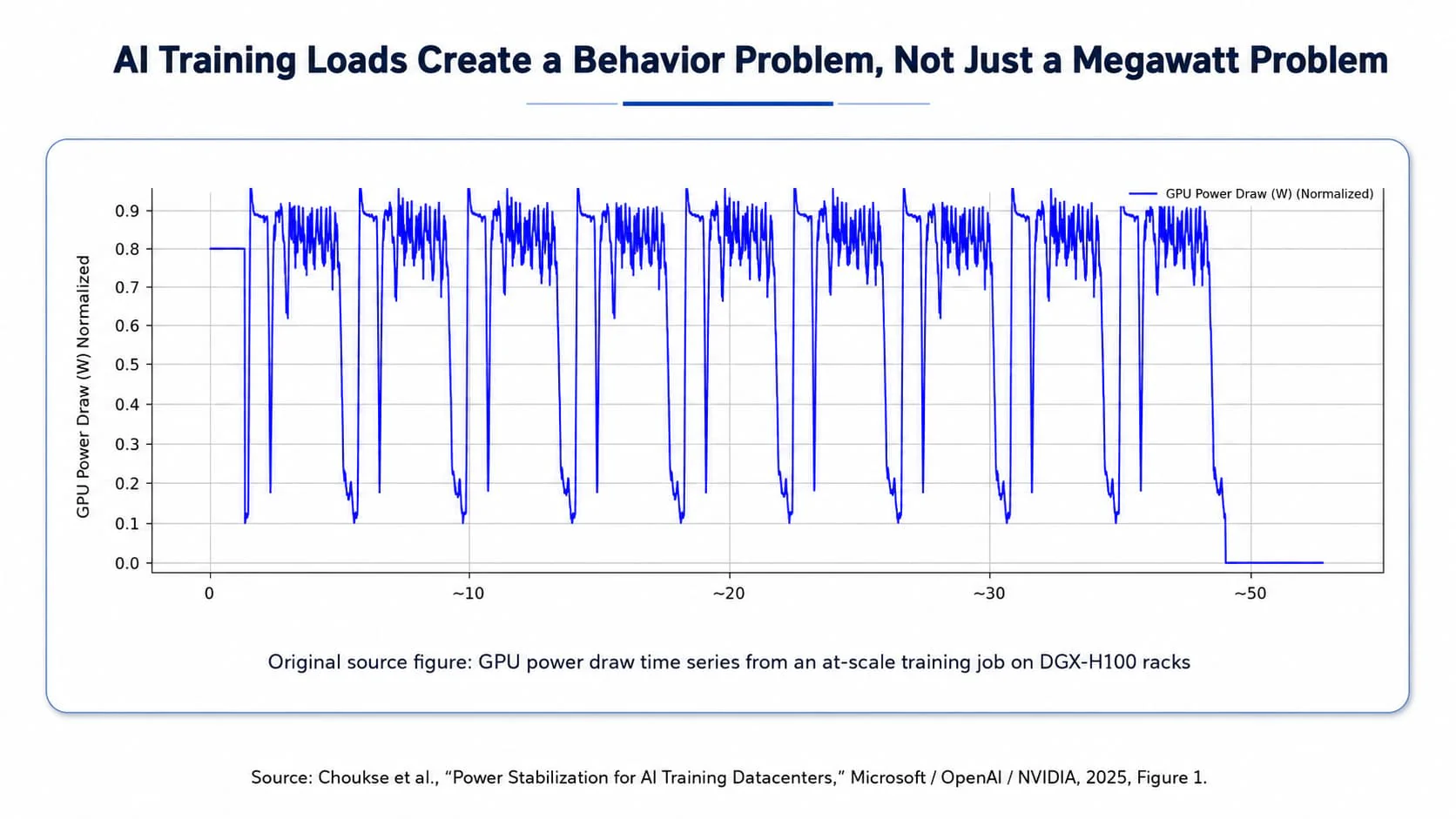
The important point is that this is not only a total-demand problem. It is a load waveform problem.
This is where the discussion becomes more technical.
Utilities and grid operators increasingly need to understand several variables.
- Ramp-up rate: How quickly does the data center increase power demand?
- Ramp-down rate: How quickly does the data center reduce power demand?
- Dynamic power range: How much short-term fluctuation is acceptable before mitigation is required?
- Frequency-domain behavior: Do workload oscillations fall into critical grid or generator resonance bands?
- LVRT and ride-through behavior: Does the facility remain connected through voltage disturbances, or does it trip and go offline?
- Protection settings: Do equipment settings avoid unnecessary disconnection during normal grid disturbances?
- Power quality: Does the facility introduce harmonics, power-factor issues, flicker, or other waveform concerns?
- Telemetry and event recording: Can operators observe and diagnose what actually happened during an electrical event?
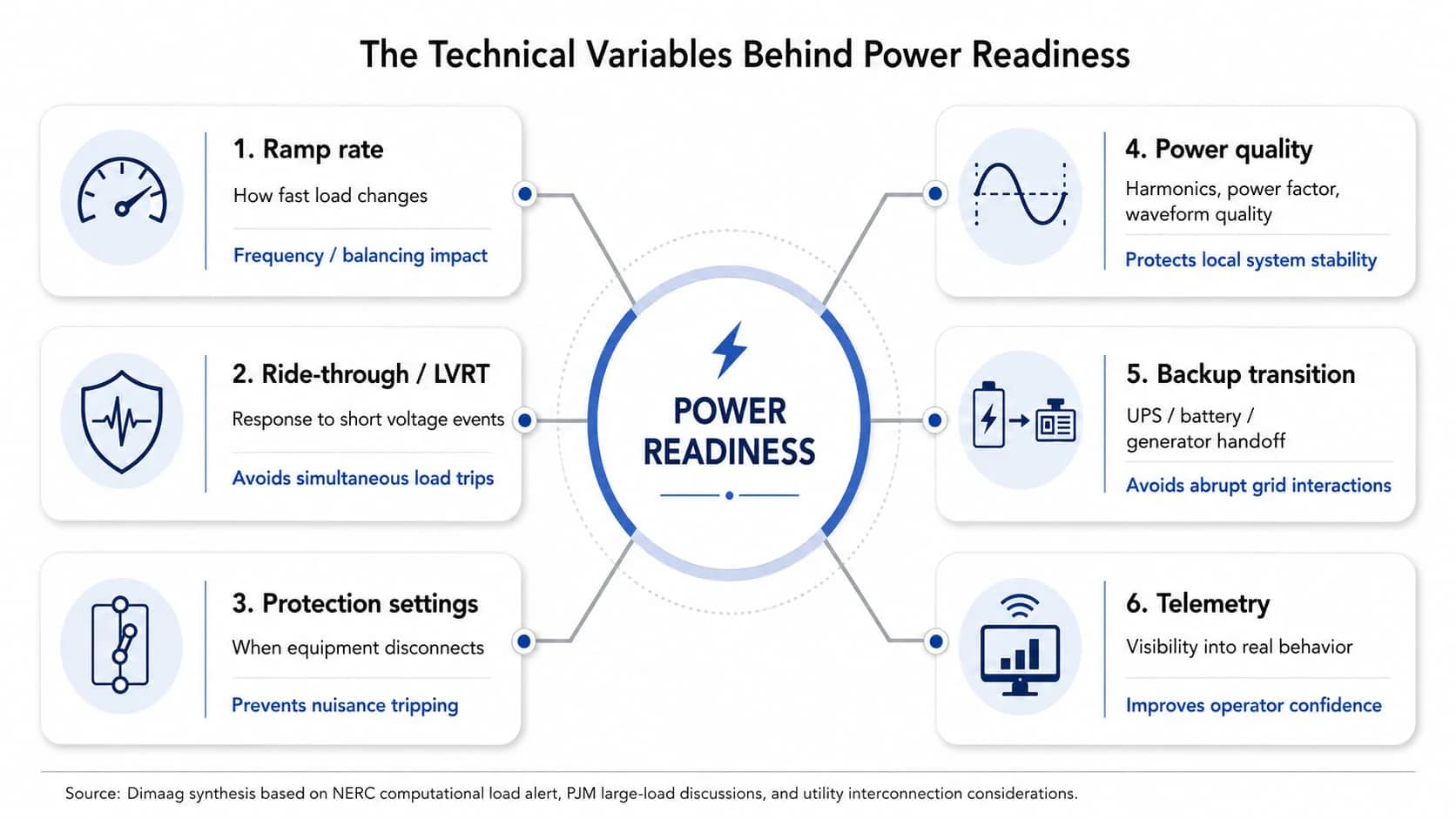
The Microsoft / OpenAI / NVIDIA paper is especially useful because it frames power stabilization across both time-domain and frequency-domain requirements. In the time domain, utilities may care about ramp-up rates, ramp-down rates, and dynamic power range. In the frequency domain, they may care about whether periodic AI workload oscillations fall into ranges that can excite grid or generation-system resonances. The paper specifically describes AI workload power traces with frequency energy concentrated between 0.2 Hz and 3 Hz, close to known resonant modes of turbine-generator shafts and long transmission lines.
This is why “just add more power” is not enough.
An AI data center needs to demonstrate that it can shape its load, smooth transitions, control ramp rates, avoid problematic oscillations, coordinate storage, and provide telemetry to operators. Power readiness is therefore not a single component. It is a system behavior.
NERC is now treating computational load behavior as a reliability topic
NERC’s May 2026 Level 3 Alert on computational loads reinforces this shift. The alert covers large computational loads, including AI training, cryptocurrency mining, and traditional data-center uses. It calls for actions related to modeling, studies, instrumentation, commissioning, operations, protection, and control.
NERC also states that the alert followed observed customer-initiated large-load reductions and significant oscillations that occur in seconds, leaving little or no time for operator intervention.
That is a significant signal. Large computational loads are no longer being viewed only as commercial load additions. They are being evaluated as reliability-relevant assets whose electrical behavior can affect the bulk power system.
This is exactly where the new power playbook must become more technical.
AI data centers will increasingly need to provide better models, better telemetry, better commissioning data, better protection coordination, and better operating procedures. Utilities and grid operators will need confidence not only in the size of the load, but in how that load responds during stress, disturbance, curtailment, and recovery.
Demand response is promising, but it must be engineered
Demand response will be part of the answer. But it should not be treated as a simple checkbox.
Some AI workloads may be shiftable. Some may not be. Some training runs may tolerate timing adjustments. Some inference or customer-facing workloads may not. Some curtailment may be acceptable if covered by storage, workload orchestration, or redundancy. Some may be commercially unacceptable.
The practical constraint is that AI workloads, service-level agreements, hardware utilization targets, customer commitments, and backup-system design all affect how much flexibility is actually available.
Flexibility has to be engineered into the facility, the software stack, the energy system, and the commercial model.
That is why the next generation of AI data centers will not simply buy power. They will need to manage power.
Power stabilization requires a cross-stack architecture
The Microsoft / OpenAI / NVIDIA paper points toward a practical architecture for this problem. It evaluates three classes of mitigation: software-based smoothing, GPU-level power smoothing, and rack-level energy storage. Each has trade-offs. Software-only mitigation can be flexible but may add performance overhead and wasted energy. GPU-level power smoothing can be more reliable, but it may still have energy overhead and dynamic-range limits. Rack-level energy storage can absorb and release power without wasting energy, but it adds hardware cost, space, and design complexity.
Most importantly, the paper argues for a multi-pronged approach: GPU-level smoothing through software or hardware, combined with rack-level energy storage, and potentially larger-scale battery systems for future deployments. It also highlights the need for co-design between the GPU and rack-level energy storage so that power stabilization can be optimized across performance, cost, energy, and utility requirements.
This is the new power playbook in technical form.
The AI power problem is not solved only at the grid edge. It is not solved only inside the GPU. It is not solved only with batteries. It is solved by coordinating across software, hardware, power electronics, storage, telemetry, controls, and utility requirements.
On-site generation and batteries are not shortcuts. They are part of a new architecture.
Many developers are exploring on-site generation, co-located generation, batteries, and grid-scale storage. That is a natural response to interconnection delays and power availability constraints.
These approaches can help. But they are not magic shortcuts.
A battery that only provides backup is useful. A battery that also supports ride-through, peak management, load buffering, power smoothing, and grid coordination is more strategic.
A generator that only supports emergency operations is useful. A generation-and-storage architecture that is integrated into the facility’s power-control logic and utility operating requirements is more valuable.
The shift is from power as insurance to power as an active control layer.
The new power playbook
The traditional data-center power playbook does not disappear. Uptime, redundancy, UPS, backup generation, and efficiency still matter. But AI data centers require additional capabilities layered on top.
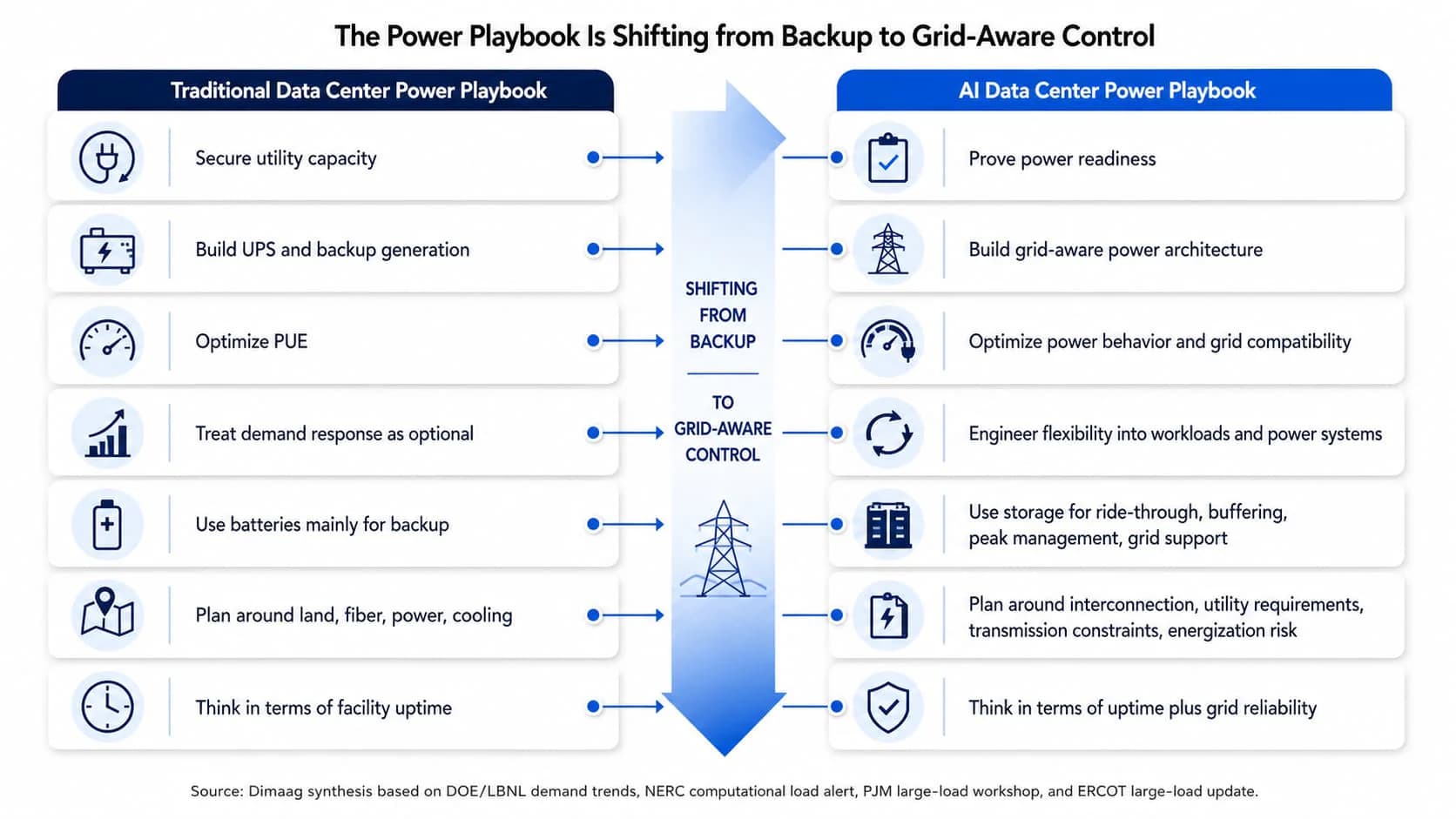
This is the core shift: AI data centers need to become power-ready before they can become truly grid-aware.
Power readiness is now a system-level capability
The new power playbook is not solved by one component.
It requires coordination across the entire power stack: utility interconnection, substations, transformers, on-site generation, batteries, UPS, power electronics, workload orchestration, instrumentation, controls, commissioning, and grid communication.
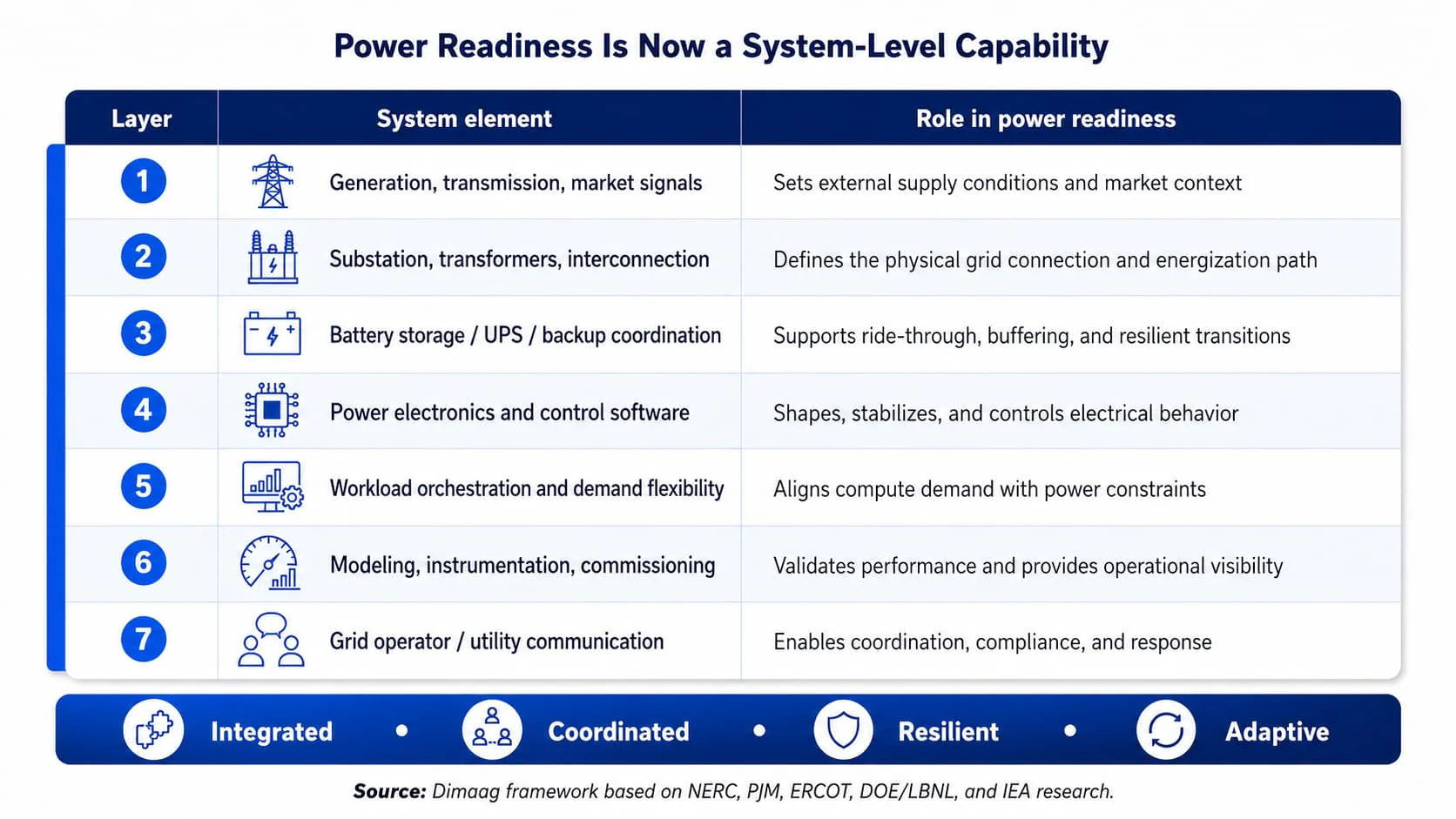
This matters because the commercial stakes are high.
For developers, power readiness affects site selection, time to energization, financing risk, customer commitments, and public approval.
For utilities and grid operators, power readiness affects forecasting, resource adequacy, transmission planning, reliability studies, protection settings, and emergency operations.
For technology providers, it creates a new category of opportunity: intelligent power systems that combine batteries, power electronics, controls software, monitoring, and grid-interface logic.
This is the emerging layer of AI infrastructure that deserves more attention.
What this means for AI infrastructure leaders
The next phase of AI infrastructure will require a broader definition of power strategy.
It will not be enough to secure capacity and protect against outages. Large-scale AI data centers will need to manage how power is drawn, shaped, buffered, and coordinated with utility requirements.
That is the shift from power protection to power readiness, and it will become one of the defining capabilities of AI-scale infrastructure.
References
U.S. data center electricity demand
- [1]
- DOE / Lawrence Berkeley National Laboratory “DOE Releases New Report Evaluating Increase in Electricity Demand from Data Centers” Used for U.S. data-center electricity consumption figures. www.energy.gov (opens in a new tab)
- [2]
- Lawrence Berkeley National Laboratory “2024 United States Data Center Energy Usage Report” Used as primary source behind Exhibit 1. eta-publications.lbl.gov (opens in a new tab)
- [3]
- International Energy Agency “Energy and AI: Energy Demand from AI” Used for global projection of 945 TWh by 2030. www.iea.org (opens in a new tab)
- [4]
- International Energy Agency “Energy and AI: Executive Summary” Used for summary of data-center electricity doubling to 945 TWh by 2030. www.iea.org (opens in a new tab)
Grid reliability and large load requirements
- [5]
- NERC “Level 3 Computational Load Alert” Used for computational loads discussion. www.nerc.com (opens in a new tab)
- [6]
- NERC “NERC Issues Level 3 Alert, Reliability Guideline Focused on Large Load Challenges” Used for observed oscillations point. www.nerc.com (opens in a new tab)
- [7]
- NERC “Project 2026-02 Computational Loads” Used for NERC standards development activity. www.nerc.com (opens in a new tab)
- [8]
- ERCOT “Official Site and Large-Load Planning Materials” Used for ERCOT context. www.ercot.com (opens in a new tab)
AI training power behavior and stabilization
- [9]
- Choukse et al. / Microsoft / OpenAI / NVIDIA “Power Stabilization for AI Training Datacenters” Used as key technical source for behavior and power stabilization. arxiv.org (opens in a new tab)